




Category: Air Quality
 November 2, 2026
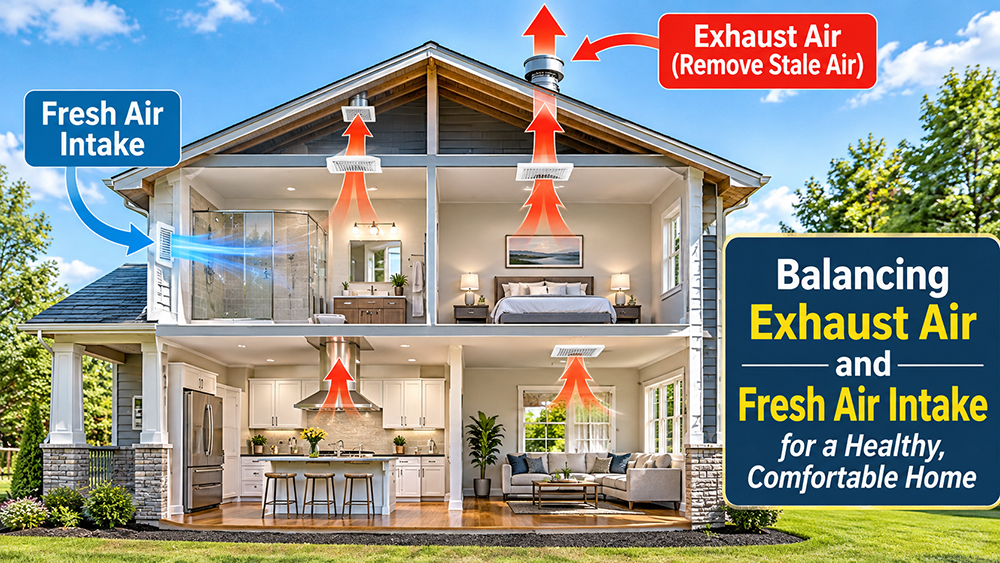
Balancing exhaust air and fresh air intake in your home is a must for a healthy home. A healthy home needs more than just good insulation, efficient heating and cooling, and clean living spaces. It also needs proper ventilation. Every day, household activities such as cooking, showering, cleaning, and even breathing introduce moisture, odors, and airborne pollutants into the indoor environment. Exhaust fans help remove these contaminants, but there is another important factor homeowners often overlook: balancing exhaust air from the home with an adequate supply of fresh air.
When exhaust fans remove air from a home without sufficient replacement air entering, pressure imbalances can develop. These imbalances may affect indoor air quality, increase energy costs, interfere with combustion appliances, and reduce the effectiveness of ventilation systems.
Understanding how exhaust air and fresh air intake work together can help homeowners create a healthier, more comfortable, and more energy-efficient living environment.
To understand why balancing exhaust air matters, it helps to look at the two basic components of residential ventilation.
Exhaust air is indoor air that is removed from a home and discharged outdoors. It often contains unwanted moisture, odors, heat, and airborne contaminants.
Common sources of exhaust air include:
Exhaust ventilation is particularly important in bathrooms and kitchens, where moisture and pollutants can accumulate quickly.
Fresh air intake is the process of bringing outdoor air into a home to replace exhausted air and provide ventilation.
Fresh air can enter through several pathways:
Although uncontrolled air leakage can introduce replacement air, it is not a reliable substitute for a properly designed ventilation system.
Fresh outdoor air helps dilute indoor pollutants and replenish the air that is continuously removed from the home.
The key is ensuring that exhaust ventilation and replacement air work together rather than against each other.
Modern homes are often constructed with tighter building envelopes to improve energy efficiency. While this reduces unwanted air leakage, it also means that homes may have fewer natural pathways for replacement air. When exhaust fans remove more air than can readily enter the home, indoor air pressure can become lower than outdoor air pressure. This condition is known as negative pressure. Negative pressure is not always a problem. However, excessive or poorly managed negative pressure can create several challenges.
When exhaust systems create negative pressure, replacement air may be pulled into the home through unintended openings, including:
Instead of entering through a planned fresh air intake, replacement air follows the easiest available path.
An exhaust fan requires a pathway for replacement air to enter the space being ventilated. If a bathroom is tightly sealed and there is insufficient airflow beneath the door or through another opening, the fan may not achieve its intended airflow. For example, a bathroom exhaust fan rated at 100 cubic feet per minute (CFM) may not deliver that airflow under actual operating conditions. The fan’s performance depends on factors such as duct length, duct diameter, bends, termination restrictions, and the pressure conditions within the home. Providing an adequate replacement air pathway can help the fan operate closer to its intended performance.
One of the more serious concerns associated with excessive negative pressure involves naturally drafted combustion appliances. Depending on the home’s design and equipment, negative pressure can interfere with the proper venting of combustion gases from appliances such as certain furnaces, water heaters, and fireplaces. In some circumstances, combustion gases containing carbon monoxide can spill back into the living space. This risk is particularly important in homes with atmospherically vented appliances and powerful exhaust equipment, such as large kitchen range hoods. Homes with combustion appliances should be evaluated by a qualified professional to determine whether pressure imbalances could affect safe operation. Carbon monoxide alarms are also an important safety measure.
If exhausting too much air can cause problems, would bringing in as much fresh air as possible solve them? Not necessarily.
The goal is not simply to maximize outdoor air intake. It is to provide the right amount of ventilation for the home while maintaining appropriate pressure relationships and controlling indoor pollutants. Uncontrolled or excessive outdoor air intake can create other challenges.
Outdoor air must be heated in winter and cooled, and often dehumidified, in summer. If a home brings in more outdoor air than necessary, the heating and cooling system may need to work harder to maintain comfortable indoor conditions. A properly designed ventilation strategy helps provide adequate fresh air without unnecessarily increasing the home’s energy demand.
Outdoor air conditions vary throughout the year. In humid weather, excessive outdoor air intake can introduce moisture that increases the load on the air-conditioning or dehumidification system. In cold weather, incoming air may be very dry and can contribute to low indoor humidity. Fresh air is important, but its quantity and delivery method should be appropriate for the climate and the home’s ventilation requirements.
Unplanned outdoor air entering through cracks, door gaps, and other openings can create cold drafts during winter or warm, humid drafts during summer. A controlled fresh air supply can help reduce these comfort problems by delivering outdoor air through an appropriate pathway.
Balanced ventilation generally means supplying outdoor air and exhausting indoor air at approximately equal rates under the intended operating conditions. For example, a system designed to exhaust 100 CFM while supplying 100 CFM of outdoor air has a nominally balanced airflow. However, matching the rated airflow numbers does not automatically guarantee that a home is properly ventilated.
Actual airflow depends on system design, duct resistance, fan performance, building pressure, and operating conditions. Airflow may also vary when kitchen range hoods, bathroom fans, clothes dryers, and other exhaust equipment operate. It is important to distinguish between two related concepts:
A home can have a balanced mechanical ventilation system and still experience pressure imbalances when other exhaust appliances are running. For this reason, the complete ventilation system should be considered rather than evaluating individual fans in isolation.
Several approaches can help homeowners and building professionals maintain appropriate airflow.
Makeup air is replacement air supplied to compensate for air removed by exhaust equipment.
In a bathroom, makeup air may enter through the gap beneath the door or through an appropriately designed transfer opening from an adjoining space.
For a kitchen range hood, a dedicated makeup air system may be necessary, particularly when the hood has a high exhaust capacity.
The appropriate solution depends on the fan’s airflow, the home’s airtightness, other exhaust equipment, and applicable building codes. Makeup air should be introduced in a way that supports effective ventilation without creating uncomfortable drafts or drawing contaminants from undesirable locations. Using a product such as the Air King QFAMD with temperature and humidity settings provides a controlled way to bring fresh air into the home.
Oversized exhaust fans can remove more air than necessary for a particular application, potentially increasing pressure imbalances and energy use. Undersized fans may fail to remove moisture and pollutants effectively.
Bathroom exhaust fans should be selected based on the room’s size, layout, applicable ventilation requirements, and expected use.
Kitchen range hoods should be selected according to cooking needs, appliance configuration, capture performance, and applicable makeup air requirements.
Choosing the right fan is an important step toward achieving effective ventilation without creating unnecessary pressure problems.
Ventilation does not happen in isolation. A home may have several bathroom fans, a kitchen range hood, a clothes dryer, and a central ventilation system operating at different times. When multiple exhaust devices run simultaneously, their combined airflow can be substantial. A ventilation assessment should consider the combined effects of these systems, including whether adequate replacement air is available when the equipment operates.
Homeowners may notice warning signs that suggest their ventilation system needs further evaluation. Possible indicators include:
These symptoms do not necessarily prove that a ventilation imbalance exists. Other problems, such as obstructed ducts, poorly adjusted doors, or inadequate fan performance, can produce similar effects. If combustion appliances are present, have a qualified professional evaluate potential backdrafting or combustion safety concerns. Do not rely on opening a window as a substitute for a properly designed solution.
Energy-efficient homes are designed to limit unwanted heat loss and heat gain. Better insulation, high-performance windows, and air sealing can significantly reduce uncontrolled air leakage. However, reducing air leakage makes it more important to provide intentional ventilation. Without a planned approach, exhaust fans may create pressure differences that cause outdoor air to enter through undesirable pathways. A well-designed ventilation strategy can help achieve several goals simultaneously:
The goal is to create a home that is both energy-efficient and properly ventilated—not one that is simply airtight.
Balancing exhaust air and fresh air intake in your home makes for a healthy home.
Exhaust fans play a vital role in removing moisture, odors, and airborne contaminants from residential spaces. However, exhausting indoor air is only one part of the ventilation equation. When a home removes air without providing an adequate replacement pathway, negative pressure can develop. When too much outdoor air enters without proper control, energy costs, humidity, and comfort can become concerns. The solution is a ventilation strategy that considers both sides of the equation: the air leaving the home and the air entering it. By properly sizing exhaust fans, providing appropriate makeup air, considering balanced ventilation systems, and verifying airflow through professional testing, homeowners can create a healthier and more comfortable indoor environment. A well-ventilated home is not simply a home that removes stale air. It is a home that manages the movement of air in a controlled, efficient, and safe way.
To learn more about Air King exhaust fans and fresh air intake, click on the exhaust fan link at the top of the page.